The Feminisation of Academia, Explained By Behavioural Scientists Bo Winegard and Cory Clark (youtube.com)
In academia, men prioritize more academic freedom, advancing knowledge, academic rigor, while women priortize more social justice and emotional wellbeing. ... When in truth and social equity come into conflict, which should scientists prioritize? Men 68% said truth and women 30% said truth. More women said ‘It’s complicated'. ‘Women are more likely to suppress science truth for moral reasons.’ This might have a higher effect on disciplines like anthropology, psychology, sociology, and other fields that study people closely. ... Men compete more overtly, while women compete more covertly, so we should probably, when men say something, take that more at face value, and women women say something is true, take that as something that might be a lie, it seems. Women prefer egalitarian social relations rather than goal-oriented coordinated groups. Women prioritize equality more. Men are less empathetic and sensitive to harms and more interested in explaining things mechanically, they're more likely to publish things that might be provocative but true, while women might be motivated to suppress these publications because of how strongly they feel moral threats.
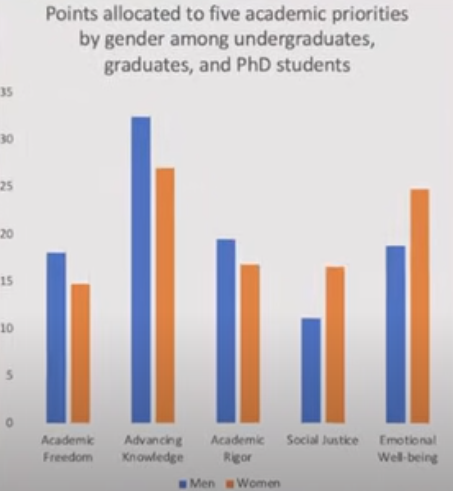
DEI statements and committments have come along with women being on boards and committees. Increased preventions of perceived-by-women harms. Trigger warnings. Sensorship and self-sensorship on campuses.
It would be funny to see gender-segregated universities again.
Commenter: 'I was a psych prof and I left academia for two reasons: 1) I wasn't able to do the research I wanted and 2) the women in the department were extreme feminists that wanted to purge the department and the university of "toxic masculinity." It was simply unbearable.'
Seems like finally Western culture is starting to come around to the effects of women with political power. Still, among those I know, about 50% still view women as incapable of doing harm, still view them as damsels and a victim in almost all interactions or relationships with men. Of those who are more critical of women, it comes somewhat martially, and is tied strongly to podcasters. Perhaps that's necessary though, because if it was just rational understanding that would likely not be enough to counteract these women-politics purposes.
Perhaps a part of this view is that even when women do cause legitimate harms, when facing people over these harms, their position is less harmful, until they are free from physical confrontation again.